
Mineral County Projected Release Meaning
WVDCR uses the documented prison-detail label Projected Release Date. It describes a future date based on information in the sentence computation at that time. West Virginia law also uses the term minimum discharge for a statement WVDCR gives an inmate, while historical VINE specifications refer to a scheduled release date. Those labels have different sources. None should be rewritten as "will be released."
An actual Mineral County release is the recorded movement out of physical custody. The destination matters. Parole or mandatory supervision moves an eligible person into supervised community status. A transfer to another WVDCR institution, the U.S. Marshals Service, or another custodian does not. Final discharge is later still when the sentence or supervision term ends.
Scheduled versus actual: A projected, scheduled, or minimum-discharge date is a calculation. The WVDCR release or movement event records what happened.
- Projected release date
- A current estimate shown for a matching active prison record.
- Minimum discharge
- WVDCR's statutory computation after authorized sentence credit.
- Parole eligibility
- The point when consideration may begin, not a right to release.
- Actual release
- The recorded departure event and destination.
- Final discharge
- Completion of the sentence or supervision term.
Mineral County Release Date Sources
The right source depends on the custody class. A person awaiting trial at Potomac Highlands Regional Jail and Correctional Facility has no sentence-based projected date. The Mineral County magistrate or circuit court controls bond, dismissal, and later case orders. PHRJCF and WVDCR hold the booking and movement record. Ask both when a court event and the physical exit must be matched.
| Custody or status | Date source | What to verify |
|---|---|---|
| Pretrial at PHRJCF | Mineral County court and WVDCR facility record | Bond or release order, then actual movement |
| Regional-jail sentence | Written judgment, jail-credit order, WVDCR computation | Credited days and actual release event |
| State prison sentence | OIS detail and WVDCR computation | Exact projected-date label and calculation date |
| Parole | Parole Board decision and WVDCR | Eligibility, grant conditions, then actual release |
| Federal sentence | BOP locator and federal court docket | Federal release wording and any later custodian |
A Mineral County case can produce a WVDCR sentence served anywhere in West Virginia. Conversely, PHRJCF sits in Hampshire County while serving Mineral County. Search by person, offender number, facility, and committing or sentencing county rather than relying on geography alone.
Find Mineral County Projected Release
The official WVDCR search hub is the first public check for a state prisoner or PHRJCF detainee. Its prison search uses first and last name plus a CAPTCHA. Compare the returned offender or booking number, birth details where shown, booking or admission date, facility, and charges. Do not accept a same-name result without matching the custody episode.
- Decide whether the person is pretrial, locally sentenced, state sentenced, or in federal custody.
- Open WVDCR OIS, read its disclaimer, and choose the prison or jail route that matches.
- Search the exact name and compare all available identifiers before opening the detail.
- Copy the field label and date exactly. Record when the search was checked.
- Obtain the Mineral County judgment and later jail-credit or amended orders from the correct court.
- Ask WVDCR for the current sentence computation when the date is absent or conflicts with the order.
- After the expected date, confirm the actual release or movement record and destination.
The WVDCR OIS menu shown below identifies the jail, prison, daily incarceration, and special-status search routes.
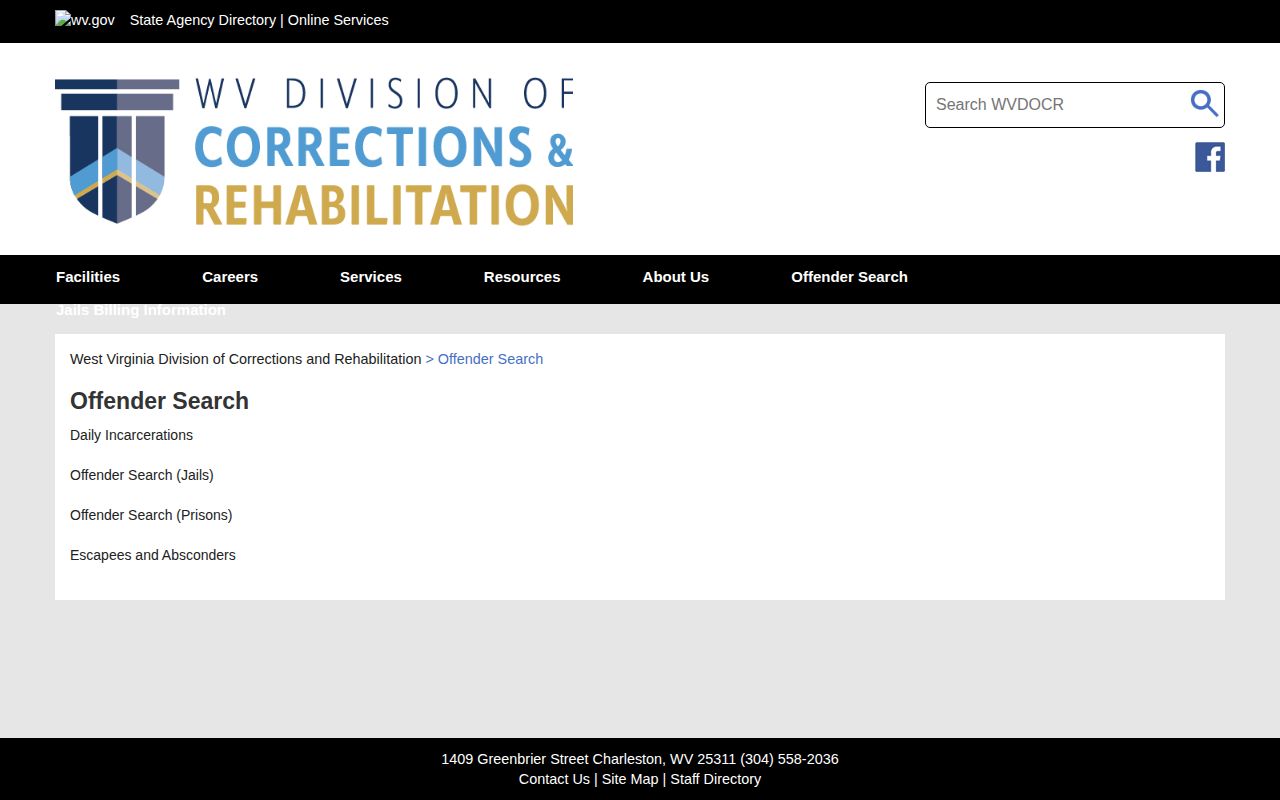
This screen is a route into current information, not an archive of every discharged person. A fully discharged person may return no result.
The OIS disclaimer says data may not show the true current location, Mineral County release date, or status. That warning does not make the projected field useless. It means the date must be attributed to OIS as of the retrieval time and checked against WVDCR's current computation.
Mineral County Good-Time Release Rules
West Virginia does not impose a universal federal-style rule that every prisoner must serve 85 percent. The general WVDCR framework is West Virginia Code section 15A-4-17. For eligible adults in the Commissioner's custody, it grants one day of good time for each day physically confined, including qualifying presentence jail days that the sentencing court credits. The credit is deducted from the maximum of an indeterminate sentence or the fixed determinate term.
Eligibility has limits. Life sentences do not earn this credit, and the statute contains other exclusions. Good time is also conditional. Discipline can cause forfeiture of some or all credit, and restoration requires the authorized approval. Consecutive sentences are aggregated for eligible good-time treatment. The Commissioner may award specified extra good time for meritorious service or emergency duties and, for an eligible felony prisoner, up to 90 days for a qualifying approved academic or vocational program that was not already required.
Subsections (g) and (h) require a written sentence-length and minimum-discharge statement, plus a revised statement when forfeiture or restoration changes the earliest discharge. That written computation is the best source when a public OIS record omits a date. It also shows why a static online calculator cannot give an authoritative Mineral County answer.
Note: Bond time and time spent on parole are not days physically incarcerated for the statute's one-for-one good-time grant.
Mineral County Jail-Credit Computation
County and regional-jail calculations begin with the written sentencing order. Under West Virginia Code section 61-11-24, credited presentence confinement can affect a later WVDCR calculation. The court states the credit, while WVDCR applies the sentence and statutory rules. If the order is amended, the computation can change.
A short county sentence may also depend on the specific offense and governing local provisions. No single public calculator can account for every judgment, credit decision, concurrent or consecutive term, or later order. Request the judgment, any jail-credit order, and WVDCR's sentence-computation record. Then compare them line by line.
Pretrial detention is distinct. Before sentencing, there may be a possible hearing, bond condition, or plea date, but no fixed release date. A bond can be posted sooner or later, a court can alter conditions, and another detainer can prevent a community exit. Use the court docket and PHRJCF's actual movement record.
Mineral County Mandatory Supervision Dates
Section 15A-4-17 provides mandatory supervision for eligible inmates as they approach calculated discharge, subject to exclusions and procedures in the law. Physical release to mandatory supervision is not final discharge. The person remains within the sentence framework in the community for the statutory period.
Parole follows a separate path. Under section 62-12-13, general eligibility may begin after the minimum indeterminate term or one fourth of a definite term, but offense-specific limits and other rules can alter that point. Section 62-12-13a confirms that an indeterminate minimum is only eligibility for consideration. A Board grant remains discretionary and can have conditions.
Keep four dates apart: parole eligibility, projected or minimum discharge, physical release to parole or mandatory supervision, and final discharge. They may all differ. Asking only "what is the release date" can blur the event that matters.
Why Mineral Release Dates Change
A Mineral County projected release changes when the inputs change. Some changes correct prior data. Others reflect a new legal event or conduct while confined. The revised date should be documented, not guessed from a vanished search record.
| Factor | Possible effect | Record to request |
|---|---|---|
| Presentence credit | Moves the calculation when the court credits or corrects days | Judgment and jail-credit order |
| Good-time forfeiture or restoration | Moves minimum discharge later or earlier | Revised WVDCR computation |
| Consecutive or concurrent terms | Changes how sentences are combined | Judgment and computation worksheet |
| Program or service credit | May reduce time only when statute authorizes it | WVDCR credit record |
| Amended court order | Changes sentence or credited time | Filed amended order |
| Parole grant, denial, or revocation | Changes the route or time of physical release | Board decision and WVDCR event |
| Detainer or new case | Can change destination or keep the person in custody | Movement record and receiving order |
Escape time, identity corrections, and new sentence data can also matter. Record the calculation date whenever dates are compared. If OIS or VINE differs from the court expectation, ask WVDCR to identify the current computation and ask the clerk for any later order.
Confirm Mineral County Actual Release
Near the projected date, register for a person-specific event through Mineral County VINELink Inmate Search. VINE can report a participating agency's configured custody change, but feed delay and transfer wording still require care. A transfer is continued custody. A release alert is notice, not the certified release instrument.
For proof, request WVDCR's release or movement record with the date, time, release type, authority, and destination or receiving custodian. Pair it with the Mineral County court order when a local case controlled the exit. If parole applies, add the written Board decision. If the person moved into federal or immigration custody, use that receiving system rather than calling the PHRJCF departure community release.
Note: A no-result response after the projected date is inconclusive because discharge, alias issues, data lag, and system scope can each cause it.
Request Mineral County Release Fields
When the Mineral County forecast has passed, ask WVDCR for named existing records rather than a new explanation. A focused request identifies the full name, aliases, date of birth if known, offender or booking number, approximate custody dates, Mineral County as the committing or sentencing county, and PHRJCF or the known state institution. Ask for electronic copies when practical.
The useful fields are admission date and time, actual release or transfer date and time, release type or movement reason, releasing authority, destination or receiving custodian, and the sentence-computation or discharge document. A transfer destination resolves whether someone entered the community or simply moved to another agency. If WVDCR separates jail movement records from offender legal records, allow the request to be routed to the unit that keeps each part.
West Virginia FOIA section 29B-1-3 applies to existing nonexempt records and requires reasonable specificity. It does not require a custodian to create a custom calculation or narrative. If an item is withheld, request the stated exemption and any reasonably segregable nonexempt fields. The Mineral County court clerk separately holds the filed judgment, jail-credit order, and later amendments that explain the legal basis for the computation.
Keep the projected-date capture with the later response. The two records show the forecast and outcome without treating a changing public screen as an error by itself. If the dates conflict, ask WVDCR whether the cause was credit, discipline, a new order, parole action, or another correction, and ask the clerk whether a later order entered the case.